

Sep 13, 2026
People tend to think of pedestrian law as a single rule about crosswalks. In practice, a driver’s duty to pedestrians in ND is assembled from several statutes that work together, and understanding how they interact explains why a pedestrian crossing mid-block may still have a claim.
At Vogel Law Firm, our attorneys handle these cases in Burleigh County and across the state, and the misunderstanding below comes up in nearly every one of them. What follows is a walk-through of the actual duties North Dakota law imposes, all found in chapter 39-10 of the North Dakota Century Code.
Key Takeaways about Pedestrian Crosswalk Laws in Bismarck
- North Dakota section 39-10-30 imposes a general duty of due care on every driver to avoid colliding with any pedestrian, and it applies notwithstanding other provisions of the chapter.
- Section 39-10-28 requires drivers to yield to pedestrians in crosswalks and prohibits passing a vehicle stopped for a crossing pedestrian.
- A pedestrian crossing outside a crosswalk must yield to vehicles, but that does not eliminate the driver’s duty of care.
- Drivers owe heightened precaution when they observe a child or a confused, incapacitated, or intoxicated person.
- North Dakota’s modified comparative fault rule divides responsibility proportionally rather than barring a partly at-fault pedestrian’s claim.
What Duties Do Drivers Owe Pedestrians in North Dakota?
A driver’s duty to pedestrians in ND is broader than the crosswalk rules most people know, because North Dakota imposes a general duty of due care that applies no matter where a pedestrian is walking. Yielding in crosswalks is one specific obligation layered on top of that baseline.
- Drivers must yield to pedestrians crossing within a crosswalk when signals are not controlling traffic.
- Drivers may not pass a vehicle stopped at a crosswalk to let someone cross.
- Every driver owes due care to avoid striking any pedestrian, including one crossing unlawfully.
That last point is the one most drivers and most injured pedestrians get wrong.
The Baseline Duty of Due Care
Every driver in North Dakota owes pedestrians a general duty of due care, and this is the foundation the specific rules sit on. Section 39-10-30 requires every driver to exercise due care to avoid colliding with any pedestrian, to give warning by sounding the horn when necessary, and to exercise proper precaution upon observing any child or any confused, incapacitated, or intoxicated person.
Read the opening words of that section closely. It applies notwithstanding other provisions of the chapter or any local ordinance, which means it is not canceled out by a pedestrian’s own violation of a different rule.
This is why the framing matters. A driver cannot satisfy their legal obligations simply by pointing out that the pedestrian was somewhere they should not have been.
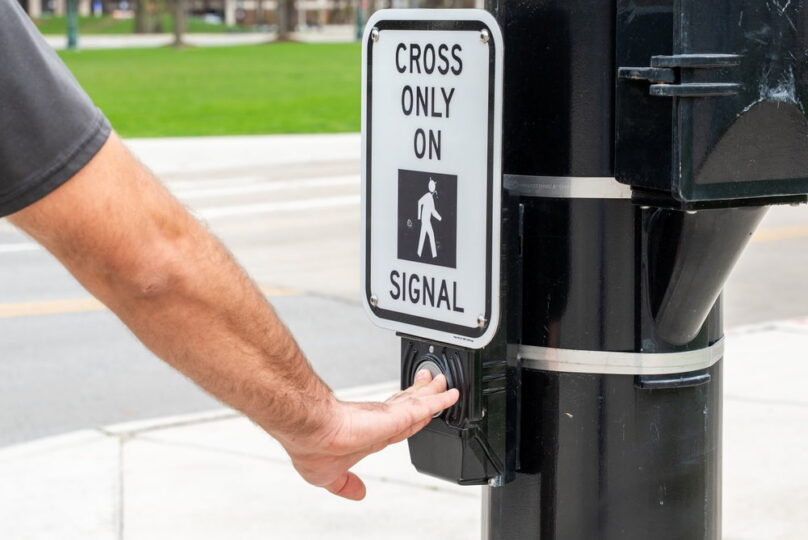
When Must a Driver Yield in a Crosswalk?
A driver must yield whenever traffic signals are not in place or not operating and a pedestrian is crossing within a crosswalk on the driver’s half of the roadway, or approaching from the other half closely enough to be in danger. Section 39-10-28 requires the driver to slow down or stop if that is what yielding takes.
Two features of that section are easy to miss. It covers unmarked crosswalks at intersections, not only painted ones, so the absence of white lines does not mean the absence of a crosswalk. And it reaches pedestrians who are still on the far half of the road but are closing in.
The section also contains a rule that prevents a recurring type of collision. Where a vehicle has stopped at a marked or unmarked crosswalk to let a pedestrian cross, a driver approaching from behind may not overtake and pass that stopped vehicle.
That prohibition addresses the multiple-threat crash directly, and it is one of the more frequently violated duties on wide streets such as State Street or Washington Street in Bismarck.
Do Pedestrians Outside a Crosswalk Lose All Protection?
No, and this is the most consequential misunderstanding in pedestrian cases. A pedestrian crossing outside a crosswalk must yield to vehicles under section 39-10-29, but the driver’s separate duty of due care under section 39-10-30 continues to apply.
These two provisions do different work. One tells the pedestrian who has the right of way. The other tells the driver they must still try not to hit anyone.
So a driver who was speeding, distracted, or not looking where they were going may bear substantial responsibility for striking someone crossing mid-block. The pedestrian’s failure to yield becomes a factor in dividing fault rather than an automatic defense.
Section 39-10-29 also sets a specific limit worth knowing. Between adjacent intersections where traffic signals are operating, pedestrians may cross only in a marked crosswalk.
Special Duties: Sidewalks, Children, and Vulnerable Pedestrians
North Dakota singles out several situations for heightened driver obligations. These come up constantly in real cases and are less widely known than the crosswalk rule.
The specific duties include:
- Section 39-10-33.1 requires a driver to yield the right of way to any pedestrian on a sidewalk, which most often applies where a driveway or alley crosses a walk.
- Section 39-10-33.3 requires a driver to yield to an individual who is blind or visually impaired carrying a clearly visible white cane, or to an individual with a disability accompanied by an assistance dog.
- Section 39-10-30 requires proper precaution upon observing a child or a confused, incapacitated, or intoxicated person.
The child provision deserves emphasis, given insurers’ approaches to these claims. A driver who sees children near a roadway is legally required to exercise greater care than the ordinary standard demands, which directly contradicts the argument that a child simply darted out.
What Do Traffic Signals Require of Turning Drivers?
Turning drivers must yield to pedestrians lawfully in an adjacent crosswalk, even when the driver has a green light or a lawful right turn on red. Section 39-10-05 sets this out in the traffic signal rules.
A driver facing a circular green may proceed or turn, but that traffic, including vehicles turning right or left, must yield to pedestrians lawfully within the intersection or an adjacent crosswalk. A green arrow carries the same obligation.
Right turn on red is the higher-risk movement. A driver may cautiously turn right on a steady red after stopping, and must yield to pedestrians lawfully in the adjacent crosswalk, yet drivers making this turn are typically looking left for a gap in traffic rather than right at the crosswalk they are about to enter.
This is a common fact pattern in claims we handle. The driver genuinely did not see the pedestrian, and that lack of observation is the failure rather than the excuse.
How Shared Fault Works in a Pedestrian Claim
Shared fault reduces a pedestrian’s recovery proportionally rather than ending the claim. North Dakota applies modified comparative fault under North Dakota Century Code section 32-03.2-02, meaning contributory fault does not bar recovery unless it was as great as the combined fault of everyone else who contributed.
The arithmetic is straightforward. A pedestrian claim valued at $200,000 with 25% of the fault assigned to the pedestrian, pays $150,000. Recovery is barred only when the pedestrian’s share reaches the level of all other contributing fault combined.
Insurers in pedestrian cases routinely open with a high fault percentage against the injured person. That number is a negotiating position built on the driver’s account of events, and it moves once signal timing, sightlines, vehicle speed, and independent witnesses are examined.
Fault percentages are ultimately for a jury, and section 32-03.2-02 lets any party require the jury to return separate findings on damages and on each person’s share of fault.
Do Pedestrians Get No-Fault Benefits in North Dakota?
Yes. A pedestrian struck by an insured vehicle in North Dakota is generally entitled to basic no-fault benefits through the insurer of the vehicle that struck them, regardless of fault. Many injured pedestrians never learn this.
Those benefits come from the Auto Accident Reparations Act and cover economic losses, including medical expenses and work loss, with a statutory minimum of $30,000 per person. We explain how no-fault benefits operate in more detail elsewhere on our site.
A separate liability claim against the driver runs on its own track. To reach noneconomic damages such as pain and suffering, the injury must qualify as a serious injury, meaning death, dismemberment, serious and permanent disfigurement, disability beyond 60 days, or medical expenses above $2,500. Pedestrian injuries frequently clear that threshold without difficulty.
If the striking vehicle was uninsured, your own coverage or the North Dakota Automobile Assigned Claims Plan may supply benefits instead.
How We Handle Pedestrian Claims in Bismarck
At Vogel Law Firm, our first priority in a pedestrian case is establishing what the driver could and should have seen. That analysis is what separates a genuine failure to yield from an unavoidable event, and it depends on evidence that does not last.
Signal timing records, business surveillance video, streetlight conditions, and the sightlines created by parked cars or snowbanks all matter, and several of those change or vanish within days. At Vogel Law Firm, we move on preservation before we argue about liability.
Our firm has practiced in this region since 1880, and our attorneys try cases in Burleigh County District Court and the South Central Judicial District. We handle injury and wrongful death claims across North Dakota and Minnesota, and with more than 40 attorneys across three offices, we can bring reconstruction and other resources to bear where a case warrants it. Our personal injury matters are handled on a contingency fee basis.
FAQs about Driver Negligence in Pedestrian Accidents
These are the questions we are asked most often about how North Dakota law allocates responsibility between drivers and pedestrians.
Does a pedestrian always have the right of way in North Dakota?
No, and the phrase is misleading. Right of way depends on the location and the signals, so a pedestrian in a crosswalk generally has it while a pedestrian crossing mid-block generally does not. What does not change is the driver’s duty of due care, which applies in both situations.
What if the pedestrian was crossing against a walk signal?
Crossing against a signal is a pedestrian violation and will be raised as contributory fault. It does not automatically defeat a claim, because North Dakota divides fault proportionally and because the driver’s own conduct still gets examined. Speed, attention, and what the driver could see remain central questions.
Is an unmarked crosswalk really a crosswalk?
Yes. North Dakota’s crosswalk rules apply at unmarked crosswalks at intersections as well as marked ones, so the lack of painted lines does not remove a driver’s duty to yield. Drivers often assume otherwise, which is precisely why these collisions happen at ordinary residential intersections.
Who is responsible if a pedestrian is struck in a parking lot?
Parking lot collisions are typically evaluated under ordinary negligence rather than the rules of the road, since private lots are not always public highways for statutory purposes. Backing drivers bear significant responsibility given their limited visibility. Property owners may also share responsibility where lighting, layout, or snow removal contributed.
Does a driver’s cell phone use affect a pedestrian claim?
It can matter a great deal. A distracted driver has failed the due care standard almost by definition, and phone records obtained through the claim process can establish use at the time of impact. This is one reason acting early is worth it, since those records are more readily secured while a claim is active.
What deadline applies to a pedestrian injury claim?
Most personal injury actions in North Dakota must be brought within six years of the injury under North Dakota Century Code section 28-01-16, while wrongful death claims carry a two-year deadline. Claims involving injured children follow different timing rules worth asking about specifically. The evidence in pedestrian cases degrades far faster than either deadline.
Can a city be responsible for a dangerous crossing?
Claims against a public entity over signal timing, signage, or roadway design are possible but follow different procedures and notice requirements than claims against a driver. Those requirements can be short and unforgiving. If a crossing itself seems to be the problem, raise it early so the additional deadlines are not missed.
Talk With Us About Your Pedestrian Injury Claim
North Dakota law asks more of drivers than most drivers realize, and a pedestrian crossing outside a crosswalk has not forfeited the protection of that law. The question in nearly every case is what the driver should have seen and done.
If you or a family member was struck by a vehicle while walking, we would like to review the circumstances before the evidence is gone. Call our Bismarck office at 701-258-7899, or reach out to us here.